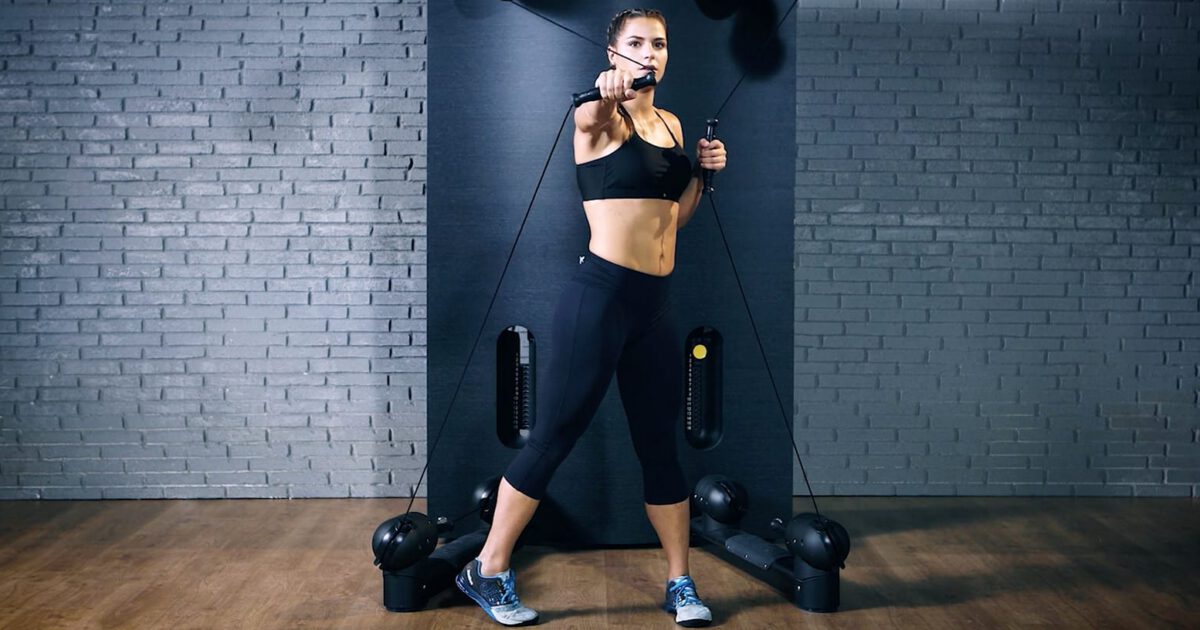
Kinesis Twisting Punches is a functional exercise that uses the Kinesis One extensively. It’s an exercise that works on your chest and arms and mobilizes the trunk stabilization simultaneously.
The Kinesis Twisting Punch allows you to activate your whole-body fluidly, transferring forces from legs to the trunk, then to the arms and back again on the same path. This way, you’ll increase your coordination, improve chest strength and trunk power.
WHAT
- Kinesis Twisting Punches is a functional exercise performed on Kinesis One.
- Strengthens your chest and arms, and mobilizes the trunk with some stabilization at the same time.
- It generates power and strength transference from the lower to the upper body.
HOW
- With your back turned to the Kinesis One, grab the cable grips with your hands close to your trunk and arms flexed. Feet should be at shoulder-wide.
- Activate your core.
- Rotate your ankle and point the front of the foot inwards.
- As you twist your hip using your core, use your chest to stabilize the scapula and extend your arm forward until your arm is fully stretched.
- Return to starting position.
WHY
- Increases functional strength and mobility in a full body activation mode.
- Promotes core activation.
- Promotes coordination.
- Promotes joint mobility.
- Increases power.
- Increases agility.